


In modern high-throughput manufacturing, mechanical and electrical equipment stability dictates a facility’s bottom line. For Original Equipment Manufacturers developing high-voltage distribution networks, automated powertrain systems, and heavy industrial machinery, component reliability is the ultimate performance metric. Hidden hotspots, localized insulation breakdown, and micro-scale friction spikes within motor bearings represent silent liabilities. Left unmonitored, these thermal anomalies lead to catastrophic asset failures, safety hazards, and expensive unplanned downtime.
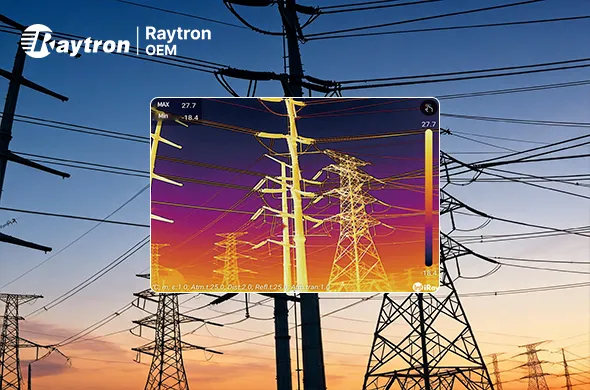
To mitigate these risks, leading industrial equipment design teams are shifting from reactive maintenance to automated, non-contact predictive diagnostics. Integrating Long-Wave Infrared thermal imaging cores directly into machinery architectures has emerged as the premier method for establishing all-weather, continuous thermal intelligence across complex asset grids.
Why LWIR is the Benchmark for Industrial Intelligence
Within the optoelectronic spectrum, the Long-Wave Infrared band (8–14μm) serves as the optimal window for industrial monitoring ranging from -40°C to over 1200°C. This band directly aligns with the natural peak thermal radiation emitted by room-temperature objects and high-load electrical components.
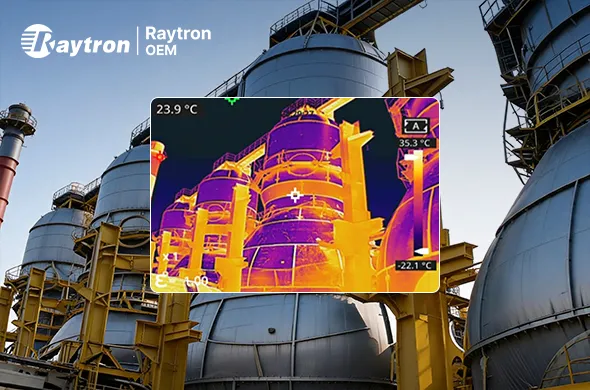
Operating entirely passively, LWIR requires no external illumination or active illumination sources. Its long wavelength provides superior atmospheric penetration, meaning it cuts through the heavy smoke, oil mist, airborne dust, and high humidity common to harsh factory environments.
For system integrators, uncooled LWIR modules offer clear advantages over alternative sensing methods:
- Non-Contact Continuous Auditing: Unlike traditional thermocouples that require point-contact and introduce wiring complexity, an LWIR sensor monitors entire surface areas simultaneously, detecting thermal gradients in real time.
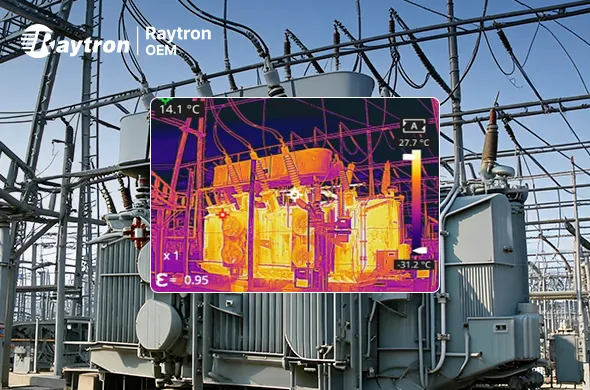
- Root-Cause Discovery Through Smoke & Dust: It pierces environmental shielding to capture early-stage friction and electrical resistance anomalies before they manifest as visible damage.
- Exceptional SWaP Profiles: Modern uncooled microbolometers deliver high thermal sensitivity (low NETD) within compact, lightweight, and low-power envelopes, allowing seamless mechanical housing integration without expanding the final product footprint.
According to verified industrial automation data, the structural deployment of radiometric thermal imaging reduces unplanned facility downtime by an average of 34% while slashing overall asset maintenance overhead by 25% to 30%.
What OEMs Gain from LWIR Integration
Integrating a high-performance thermal core into an OEM product line delivers three distinct levels of commercial and technical value:
1. Accelerated Engineering and Reduced R&D Cycles
Industrial product development teams operate under strict time-to-market constraints. Choosing highly consolidated, uncooled LWIR modules equipped with universal standard interfaces removes the burden of low-level sensor design. Engineering teams can leverage pre-calibrated radiometric data outputs directly within their proprietary software, cutting system adaptation timelines from quarters to weeks.
2. Enhanced Edge-AI Predictive Capabilities
Modern automated factories rely heavily on edge-computing AI models for condition monitoring. High-sensitivity Vanadium Oxide (VOx) detectors deliver low-noise, high-contrast thermal matrices. This clean data input allows localized machine vision algorithms to perform precise Region of Interest (ROI) tracking, automated threshold crosshair identification, and early anomaly trend analysis without overloading processing units.
3. True Industrial-Grade Field Reliability
Factory floors are brutal environments characterized by intense mechanical shock, severe thermal cycling, and constant electromagnetic interference. Industrial-grade thermal cores are built with wide-temperature compensation algorithms and ruggedized structural architectures. This guarantees stable, drift-free temperature measurements 24/7/365, preserving the end-product’s reputation for uptime in the field.
Strategic Architectural Options for Integrators
To meet the diverse spatial and economic targets of industrial system designs, hardware architects typically choose between two core integration pathways:
- High-Resolution thermal module
High-resolution thermal modules are ideal for fixed industrial monitoring systems, including automated substations, electrical cabinets, production lines, and permanent condition-monitoring installations.
With resolutions such as WN2 thermal module‘s 640 × 512, these radiometric cores provide exceptional image detail, enabling the detection of small thermal anomalies from a safe distance. Whether identifying a loose electrical terminal, an overheating circuit connection, or localized temperature rise in transformer bushings, high-resolution cores deliver the accuracy required for early fault detection and predictive maintenance.
- Compact thermal module
For applications where space and weight are critical—such as mobile inspection robots, robotic arms, UAV payloads, and handheld thermal inspection devices—compact LWIR thermal cores offer an optimized SWaP-C solution.
Their lightweight, low-power design simplifies system integration without requiring significant mechanical redesign. By minimizing payload and power consumption while maintaining reliable thermal performance, compact cores enable OEMs to develop intelligent industrial equipment with greater design flexibility and faster time to market.
As the global manufacturing sector marches toward total automation, basic operational monitoring is no longer enough. To win high-value contracts, Electrical and Mechanical OEMs must offer smart machinery capable of self-diagnosis and autonomous asset protection.
Integrating advanced uncooled LWIR modules converts standard hardware into an intelligent, data-rich asset. By pairing ruggedized vanadium oxide sensor reliability with highly adaptable optomechanical configurations, OEMs can deliver end-products that defend against safety failures, lower operational costs, and solidify market leadership within the industrial intelligence space.
About Raytron OEM
Raytron OEM, a wholly-owned subsidiary of Raytron Technology Co., Ltd., is a leader in uncooled infrared thermal imaging. With full-stack capabilities from IC and MEMS sensor design to system integration, we deliver high-performance infrared solutions for industrial monitoring, wildfire prevention, outdoor night vision, consumer electronics, and intelligent sensing. Guided by our mission, “To Create Incremental Value for Customers with Technological Advancements”, we continue to drive innovation and empower smarter, safer, and more efficient systems worldwide. For more on the Raytron Microelectronics program, visit: https://www.raytron-microelectronics.com/contact-us